How RAG Systems Can Transform Maritime Fleet Operations
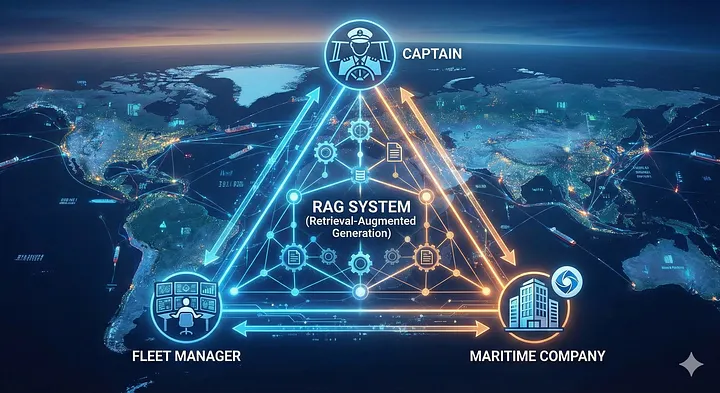
Turning Technical Documentation Into Real-Time Decision Support
The Problem Every Fleet Manager And Every Officer OnBoard Know:
Picture this: It’s 2 AM in the engine room of a commercial vessel. An engineer encounters an unusual alarm on a main engine. They grab the manufacturer’s manual — a 500-page PDF in German. They search through pages of diagrams. They call the shore-based technical team. Hours pass. Productivity suffers. The superintendent eventually solves it, but the knowledge gained is siloed on that one ship.
Meanwhile, on another vessel in the fleet, the same issue occurred three months ago. A senior engineer solved it elegantly. But that solution lives in scattered technical logs and email threads.
This is the maritime industry’s hidden productivity drain. Knowledge exists, but it’s fragmented, inaccessible, and often lost when experienced crew members retire.
What if every crew member could access decades of collective operational wisdom instantly? What if a junior officer could ask: “Show me all maintenance procedures for this turbocharged engine,” and receive a synthesized answer sourced directly from manuals, SMS procedures, and 12 months of operational logs — in seconds?
That’s what RAG systems enable.
What Is RAG? (And Why It’s Different from ChatGPT)
When you ask ChatGPT a question, it’s drawing on a vast, general knowledge base trained on public internet data. Useful for general questions. Useless for your maritime operations.
RAG stands for Retrieval-Augmented Generation. It’s a fundamentally different architecture:
The Core Principle: Force AI to “forget the world” and answer questions only based on your company’s private, trusted documents.
How It Works (Simple Version)
Library Creation: Upload your fleet’s documents into a secure, searchable database
- Manufacturer manuals
- SMS (Safety Management System) procedures
- Technical specifications
- Operational logs and maintenance histories
- Fuel efficiency guidelines
Retrieval: When someone asks a question, the system searches your private library for relevant information
- No guessing or hallucination
- Only your verified documents matter
Generation: The AI synthesizes an answer from those documents, citing sources
- “According to Sulzer Engine Manual, Section 4.2…”
- “Based on your SMS procedures and last 6 months of logs…”
Why This Matters for Maritime
Unlike general ChatGPT, RAG ensures:
- ✅ Accuracy: Answers come from authoritative sources, not AI guesswork
- ✅ Compliance: Audit trails show exactly which procedures were consulted
- ✅ Data Security: Information never leaves your company’s environment
- ✅ Fleet Consistency: Same answers across all vessels (no variation based on crew knowledge)
Four Strategic Benefits for the Fleet
1. Break Knowledge Silos
Current state: When a complex issue is solved on Vessel A, that solution often stays on Vessel A. The crew on Vessel B later faces the same problem and “reinvents the wheel.”
With RAG: Solution methodology from Vessel A is instantly indexable and available to every vessel in the fleet. Institutional knowledge becomes a competitive asset, not a liability.
Impact: Reduce troubleshooting time by 40–60%. No more weeks searching for that one email from five years ago.
2. Enable Real-Time Compliance & Sustainability Decisions
Decarbonization regulations evolve constantly. CII requirements change. Port State Control standards tighten. Your superintendent needs immediate answers:
- “What’s the exact financial and CII penalty if we run 1.5 knots faster on this route?”
- “What maintenance decisions impact our EEXI compliance?”
- “Show me the approved fuel types and their emissions impact.”
Current approach: Query compliance officers, wait hours or days.
With RAG: Combine operational data + regulatory constraints + historical decisions. Instant answer.
Impact: Agile regulatory response. Competitive advantage in emissions tracking. Reduced compliance risk.
3. Preserve Institutional Memory
Maritime expertise is expensive and fragile. When a 25-year veteran chief engineer retires, their deep knowledge about vessel-specific maintenance quirks often leaves with them.
RAG digitizes that wisdom:
- Captures troubleshooting methodologies from technical logs
- Indexes SMS procedures interpreted by experienced crew
- Preserves vessel-specific operational insights
- Makes a junior engineer’s onboarding 10x faster
A new officer can ask: “What were the last 5 times this pump cavitated, and how was it resolved?” and get context instantly.
Impact: 50–70% faster crew onboarding. Reduced errors from inexperienced crews. Continuity despite staff turnover.
4. Drastically Reduce Mean Time to Repair (MTTR)
MTTR is a financial metric: every hour a ship spends troubleshooting instead of operating costs money.
- 1 hour searching PDF manuals for a torque specification = lost revenue
- 2 hours waiting for shore support to confirm a procedure = lost revenue
- 30 minutes of downtime finding a spare part number in technical logs = lost revenue
RAG eliminates this waste. An engineer asks: “Torque spec for cylinder head bolts on the Sulzer ZV40?” Answer appears in 5 seconds.
Impact: 15–25% reduction in MTTR. Direct bottom-line savings.
The Practical Pilot: Fleet Technical Management
To demonstrate value without massive initial investment, here’s how a typical 4-week pilot unfolds:
Week 1–2: Knowledge Ingestion
- Upload 2–3 years of vessel documentation
- Manufacturer manuals (PDF)
- SMS procedures relevant to engine room operations
- Fuel consumption logic and baseline data
- Technical logs and maintenance records
Week 3: System Configuration
- Configure AI search to understand technical diagrams, specifications, and complex procedures
- Set up vessel-specific filtering (so Vessel A crew only sees Vessel A manuals by default, if needed)
- Define access controls and audit logging
Week 4: Live Trial
- Deploy chatbot interface to engine control room
- Crew submits real troubleshooting questions
- Capture feedback and refine
Week 5: Validation & Scale Decision
- Measure: Time saved per query? Crew satisfaction? Accuracy of answers?
- Decide: Expand to entire fleet or refine the scope?
Technical Architecture (Cloud-Native, Secure)
If you’re already invested in cloud infrastructure, RAG integrates cleanly:
Example Stack (Microsoft-native):
- Storage: Azure Data Lake (ADLS Gen2) — secure document repository
- Intelligence: Azure OpenAI (GPT-4o) — private AI instance, data never leaves your tenant
- Search: Azure AI Search — indexes documents for rapid retrieval
- Interface: Integrated into Microsoft Teams, Power BI, or custom web app
Key Security Feature: Data is encrypted in transit and at rest. Access is audited. If you later leave this provider, your documents are portable.
Scalability: The architecture works for one vessel or a global fleet. Document volume doesn’t impact response speed significantly.
A Hybrid Approach for Maritime Operations
One important consideration: Maritime connectivity varies. Not every vessel has reliable high-speed satellite links.
A hybrid solution balances cloud + edge:
Aspect Cloud (Azure) Local Edge Server Connectivity Requires internet Works 100% offline Data Privacy Data in Microsoft’s secure cloud Data never leaves the vessel Cost Monthly subscription (OpEx) One-time hardware (CapEx) Maintenance Automatic updates IT must manage remotely Use Case Fleet-wide analysis, trend spotting Real-time troubleshooting on the vessel
Recommendation: Use cloud RAG for strategic analysis and fleet-wide insights. Use edge/local RAG on vessels for crew troubleshooting when connectivity is poor.
Real-World Questions RAG Answers
Here’s what crew actually needs:
Troubleshooting:
- “What’s the procedure for [alarm code]?”
- “What torque settings for [component]?”
- “Show me similar maintenance history for this pump.”
Compliance & Operations:
- “What’s the CII impact of this decision?”
- “Is [fuel type] approved under our SMS?”
- “Show me spare parts used most frequently in the engine room.”
Training & Onboarding:
- “Explain the fuel treatment system.”
- “What are the safety procedures for ballast tank entry?”
- “Show me the vessel’s tank arrangement.”
Without RAG: Minutes or hours to find answers (if they’re findable at all).
With RAG: Seconds, with sources cited.
Implementation Considerations
What You Need:
- Document Library — PDFs, Excel sheets, maintenance logs (you already have these)
- Cloud or Edge Infrastructure — Secure hosting for the AI and search system
- Change Management — Training crew to use the system effectively
- Governance — Define which documents are trustworthy sources
What You Don’t Need:
- Expensive consultants (RAG is increasingly commoditized)
- Months of planning (a pilot takes 4–5 weeks)
- Custom software (modern AI platforms have RAG built-in)
Cost Reality:
- Small pilot (1 vessel): €5K-10K initial + €500–1000/month
- Fleet-wide (50+ vessels): €30K-50K initial + €3K-5K/month
- ROI typically achieved within 6–12 months from reduced MTTR alone
The Competitive Advantage
In maritime, your competitive advantage increasingly comes from operational excellence, not just ship size or route optimization.
Companies that move beyond “collecting data” to “activating knowledge” will:
- Respond faster to regulatory changes
- Reduce operational downtime
- Onboard crew more effectively
- Make better sustainability decisions
- Retain institutional knowledge
RAG is the bridge from data to wisdom.
What’s Next?
If you’re managing a maritime fleet — whether container ships, tankers, RoPax, or bulk carriers — ask yourself:
- How much crew time is spent searching for information?
- When experienced officers retire, what knowledge walks out the door?
- How fast can your superintendent answer compliance questions?
- How consistent are decisions across your fleet?
If the answer to any of these is “slower than it should be,” RAG deserves a conversation.
The technology is ready. The business case is clear. The only question is: When will you move from “collecting operational data” to “activating maritime wisdom”?
About the Author
I’ve spent many years at sea as an Officer: 3rd Mate, 2nd Mate and Ch. Officer then switched to BI and data architecture, helping businesses to build intelligent systems. I’m passionate about practical AI — solutions that solve real problems for real people, in real vessels and in real time.
Keywords: RAG, Retrieval-Augmented Generation, Maritime Technology, Fleet Operations, AI in Shipping, Knowledge Management, Compliance Automation, Edge AI, Azure OpenAI
Disclaimer: This article represents general concepts and best practices. Specific implementation details vary based on fleet size, vessel types, regulatory jurisdiction, and existing IT infrastructure. Consult with maritime technology experts before implementation.